
The Great Migration in the Serengeti
How the Great Migration actually works — the year-round clockwise loop through the Serengeti–Mara ecosystem, why the rains run the show, where the herds usually move month to month, and how to plan a safari around it without pretending nature is on a timetable.

Photo: Harshil Gudka / Unsplash
- ✓The Great Migration is a permanent, year-round loop — not an annual event with a start date. The herds are always somewhere in the ecosystem.
- ✓Roughly 1.5 million wildebeest move with hundreds of thousands of zebra and gazelle, following rainfall and fresh grazing rather than a calendar.
- ✓The loop runs roughly clockwise: calving in the southern Ndutu plains, west through the Grumeti, north to the Mara crossings, then back south as the short rains break.
- ✓Two headline acts dominate planning — calving (green season, south) and the Mara River crossings (dry season, north).
- ✓Every timing here is a 30-year average. A two-week swing in either direction is normal, so verify the picture for your exact dates before you commit.
- ✓No ethical operator can guarantee a crossing or a calving frenzy on a given day — you weight the odds with the right sector, enough nights and a patient guide.
What the Great Migration really is
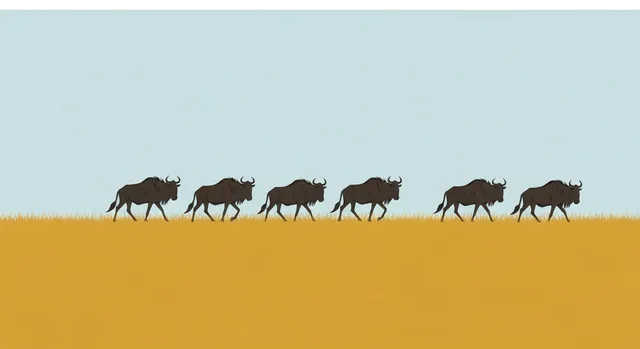
The Great Migration is often described as if it were a parade with a schedule — as though the wildebeest set off each year on a fixed date and arrive somewhere on cue. That picture is wrong, and believing it is the single most common reason travellers end up in the wrong place at the wrong time. The migration is not an event. It is a permanent, year-round movement: an enormous herd circling the Serengeti–Mara ecosystem in a rough clockwise loop, never stopping, never starting, simply flowing from one source of fresh grass and water to the next.
The cast is staggering. Around 1.5 million wildebeest form the core, but they travel with several hundred thousand zebra and large numbers of Thomson's gazelle and other plains game, all woven into the same restless column. They move because they must: the ecosystem cannot feed them in one place for long, and the rains that green the grass fall in different parts of the landscape at different times of year. So the herd follows the weather, and the weather is the one thing nobody can promise.
Understanding this changes how you plan. You are not booking a ticket to a show with a curtain time. You are deciding which chapter of an endless story you want to stand inside — and then giving yourself the best possible odds of seeing it well. That framing, more than any single date, is what separates a great migration safari from a disappointing one.
Why the rains run the show
To understand the loop, follow the water. The southern short-grass plains around Ndutu sit downwind of the Ngorongoro highlands and are dusted with mineral-rich volcanic ash. When the rains fall there — typically through the green months from around November into March — the grass that springs up is short, nutritious and perfect for grazing and for raising young. That is why the herds gather in the south to calve: not by tradition, but because the food and the open sightlines are at their best there in that window.
As those southern plains dry out and the grazing thins, the herd drifts north and west in search of the next flush of green, eventually following the rainfall belt up toward the permanent water of the northern rivers. By the height of the dry season the only reliable green and water lie in the far north and across the border in Kenya's Maasai Mara, which is why the herds press to the Mara River and gamble across it. When the short rains break again, usually around November, fresh grass reappears in the south and east, and the great wheel turns the herds back toward the calving grounds to begin again.
The practical lesson is simple and worth repeating: the migration follows rainfall, and rainfall varies year to year. A late or early wet season shifts everything. That is why this guide treats all timing as a long-run average and urges you to verify the live picture for your dates rather than trusting a fixed date you read somewhere.
- Rain greens the grass; fresh grass pulls the herds; so the herds chase the rain.
- Volcanic-ash soils make the southern plains ideal calving ground in the green season.
- In the dry season, only the northern rivers offer reliable water — hence the crossings.
- Year-to-year rainfall swings can shift the whole loop by a couple of weeks or more.
The loop, season by season
Here is the migration's year in broad strokes. Think of it as four overlapping movements rather than four sharp-edged stages — the herd is huge and strung out, so its front and tail can be in different sectors at once.
Green season, roughly December to March — the south. The herds spread across the southern Ndutu and Salei plains, fattening on the short grass. Calving peaks around February, when something on the order of half a million calves are born in a window of just a few weeks. Predators converge, and the open ground makes this the year's most intense and most visible big-cat theatre.
Long rains and transition, roughly April to May — central and west. As the southern plains dry, the columns begin moving north and west through the central Serengeti toward the Western Corridor. These are the lush, quiet, low-season months: heavier roads and scattered game, but emerald scenery and the best value of the year.
Early dry season, roughly June — the Western Corridor and Grumeti. The herds reach the Grumeti River, the migration's first serious water obstacle. Crossings here are smaller and less predictable than the Mara's but can be dramatic, with resident crocodiles waiting in the pools.
Dry season, roughly July to October — the north and the Mara. The leading herds push into the Northern Serengeti around Kogatende and to the Mara River, where the famous crossings unfold, often back and forth across the Kenyan border as the herds chase grazing. August is the classic peak, with crossings continuing into September and October.
Short rains, roughly November — the return south. As the short rains break, fresh grass reappears in the south and east, and the herds stream back down through Lobo and the central plains toward the calving grounds, closing the loop.
The two headline acts: calving and crossings
Almost everyone planning a migration safari is, whether they realise it or not, choosing between two flagship experiences — and they sit at opposite ends of the year and the map. Getting clear on which one you are travelling for is the most important decision you will make.
Calving season is the green-season drama of the south. Across roughly three weeks centred on February, the herds carpet the short-grass plains near Ndutu and give birth in extraordinary numbers. A wildebeest calf is on its feet within minutes of birth, and the sheer density of vulnerable newborns draws lions, cheetahs, hyenas and jackals in for the most concentrated predator action of the entire year. The open, treeless plains make it the best window anywhere in the ecosystem to watch a cheetah hunt in the clear. It is raw, fast and unforgettable, and it happens in the cheaper, quieter green season.
The Mara River crossings are the dry-season drama of the north. From around July, columns of wildebeest pile up on the river's banks, hesitate at the water's edge, and then pour across in a churning, crocodile-haunted rush — the single most cinematic hour in African wildlife, and the hardest to time. It is the scene most people picture when they imagine the migration. It is also the most expensive and most crowded chapter, concentrated in a handful of limited camps in the remote far north that book out far ahead.
If you cannot decide, ask what you would most regret missing — the tender, predator-charged chaos of newborns, or the heart-in-mouth gamble at the river. There is no wrong answer, only different trips.
How to plan a safari around the migration
Once you know your chapter, planning becomes a sequence of sensible choices rather than a gamble. First, pick the sector that matches your event and lock your dates to it — south for calving, north for crossings, west for the Grumeti. Second, give yourself enough nights. A single rushed day in the north is a coin-flip; three or more nights based near the river dramatically improves your odds of witnessing a crossing, and the same logic applies to calving. The migration rewards patience, and patience means time on the ground in the right place.
Third, choose accommodation by location before luxury. A mobile camp that packs up and follows the herds north for the crossing season will put you far closer to the action than a beautiful permanent lodge stranded hours away in the wrong sector. The best camp in the wrong place misses the show. Fourth, decide how you arrive: the remote north is most practical as a fly-in to the Kogatende airstrip, while the southern and central sectors combine naturally with a drive-in circuit through Ngorongoro and Tarangire.
Finally — and this is the rule that protects everything else — verify the live picture before you book and again before you travel. Because the herds move with the rains, a camp that is perfectly placed in August can be hours from the action in February. Cross-check where the herds usually are for your exact dates, and never accept a vague 'you'll see the migration' promise without asking where, specifically, and how far the daily game drives will be.
- Pick the sector that matches your event, then lock dates to it.
- Budget enough nights — three or more in the north for crossing odds.
- Choose camps by location first, comfort second; mobile camps follow the herds.
- Fly in for the remote north; drive in for the central and southern circuit.
- Verify the herds' likely position for your exact dates — twice.
Setting honest expectations
It is worth saying plainly: the migration is wild, and wildness does not perform on demand. A crossing can happen at dawn or not at all on a given day; the herds cross when they cross, driven by grazing, weather and their own collective nerve. No reputable operator can schedule one, and any promise of a guaranteed crossing should be treated as a red flag rather than a reassurance. Likewise, calving is a window, not a single morning, and the densest action depends on conditions on the day.
What you can rely on is the bigger picture. In the right sector at the right time of year, you are surrounded by one of the largest concentrations of large mammals on Earth, with predators close behind. Even on a day with no crossing, the sheer scale of the herd, the dust, the sound and the resident wildlife make for an extraordinary safari. The travellers who come away happiest are the ones who arrive curious rather than entitled — who treat the waiting as part of the spectacle, and who let the ecosystem set the pace.

The cast: who is actually on the move
It is easy to picture the migration as wildebeest alone, but the spectacle is really a moving ecosystem, and understanding its cast makes the whole thing richer. The headline performers are the wildebeest — well over a million of them — ungainly, ceaselessly grunting animals whose massed numbers create the drama, the dust and the noise that define the migration. Travelling with them, in their hundreds of thousands, are plains zebra, and the partnership is no accident: zebra graze the longer, coarser top grass while wildebeest crop the shorter growth beneath, so the two species feed without competing, and the zebra's sharper eyesight and better memory for routes complements the wildebeest's keener sense of smell for water. Smaller numbers of Thomson's and Grant's gazelle and eland move with the herds too, swelling the throng to perhaps a million and a half grazers on the move.
Behind the grazers comes the reason the migration is such a wildlife spectacle: the predators. The herds are a moving feast, and the Serengeti's lions, leopards, cheetahs, spotted hyenas and wild dogs are drawn to wherever the wildebeest concentrate, while the Mara and Grumeti rivers hold some of Africa's largest crocodiles, which wait all year for the crossing season. This is why the migration delivers such intense predator action — not because the cats migrate, but because the prey arrives at their door. During the calving in the south, the sudden glut of vulnerable newborn calves triggers the most concentrated predator activity of the entire year, as lions, cheetahs and hyenas take advantage of the easiest hunting on the calendar.
The point worth holding onto is that the migration is a story of relationships — grass, rain, grazers and hunters — rather than a single species walking in a line. That is why even a day without a river crossing can be extraordinary: you are standing inside one of the largest concentrations of large mammals on Earth, with the full predator guild close behind. When you plan a migration safari, you are really planning to witness this whole web in motion, so judge a sighting by the scale and the drama of the ecosystem around you, not by whether one specific event happened to occur on your morning. Verify where the herds and their followers are likely to be for your exact dates, and come to watch the whole cast rather than a single act.
- Over a million wildebeest are the headline, joined by plains zebra in a non-competing grazing partnership.
- Gazelle and eland swell the moving herds to perhaps a million and a half grazers.
- Lions, leopards, cheetahs, hyenas and wild dogs follow the herds; the rivers hold giant crocodiles.
- The calving's glut of newborns triggers the most concentrated predator action of the year.
- The migration is a web of grass, rain, grazers and hunters — judge a day by the whole ecosystem.
The conservation story behind the spectacle
The Great Migration is not just a spectacle to watch but a phenomenon worth understanding as one of the last great wildlife events of its kind, and that context deepens any safari. It is among the largest remaining overland migrations of large mammals on the planet, and it persists because the Serengeti–Mara ecosystem remains, for now, large enough and connected enough to let the herds complete their year-round loop. That loop depends on the animals being able to move freely across a vast landscape that crosses the Tanzania–Kenya border and spans national park, conservation area and community land. Anything that fragments that landscape — fences, roads, agriculture, water diversion — threatens the migration far more than any single year's weather does.
This is why responsible tourism matters here in a concrete way. Well-managed safari tourism gives the migration and its ecosystem an economic value that helps justify protecting the land and supporting the communities who share it, turning living wildlife into a sustainable asset rather than an obstacle. As a traveller you contribute most by choosing operators and camps with genuine conservation and community credentials, by following the etiquette that keeps the wildlife wild — keeping a respectful distance, never crowding a crossing, not littering, staying in the vehicle — and by treating the herds as a privilege to witness rather than a show staged for you. The behaviour of visitors at the crossings, in particular, can either preserve the spectacle or degrade it.
Holding the conservation picture in mind also reframes the honest expectation-setting that runs through any migration trip. The herds move on their own terms because they are genuinely wild and genuinely free, which is exactly what makes the migration precious and exactly why it cannot be guaranteed or scheduled. The unpredictability is not a flaw to be managed away but the very thing that makes standing among a million wild animals so moving. Come to the Serengeti understanding that you are witnessing a fragile, irreplaceable natural phenomenon, choose your operator and your conduct accordingly, and the migration becomes not just a sight you ticked off but something you helped, in a small way, to keep alive.
- The migration is one of the last great overland mammal migrations, persisting because the ecosystem stays connected.
- The loop crosses parks, conservation areas, community land and the Tanzania–Kenya border.
- Fragmentation — fences, roads, agriculture, water diversion — threatens it more than any year's weather.
- Choose operators with real conservation and community credentials, and follow wildlife etiquette.
- The unpredictability that makes it un-guaranteed is exactly what makes it precious.
Frequently asked questions
When does the Great Migration happen? It happens all year — the herds are always moving somewhere in the ecosystem. There is no single season. The headline events are calving (around February, in the south) and the Mara River crossings (roughly July to October, in the north). Treat both as long-run averages and verify for your dates.
What is the best time to see a river crossing? Roughly July to October in the Northern Serengeti around Kogatende, with August the classic peak. Give yourself several nights based near the river to improve your odds, and accept that no day is guaranteed.
When is calving season? The herds gather on the southern Ndutu plains through the green months, with calving peaking around February. Roughly half a million calves are born in about three weeks, drawing the year's most intense predator action.
Can I see the whole migration in one trip? No — the herd is enormous and strung across the landscape, and the loop takes a full year. You see one chapter per visit. Choose the chapter you most want and place your trip around it.
Is the migration ever in Kenya's Maasai Mara instead? Yes. During the dry-season crossing months the herds move back and forth across the Kenyan border as they chase grazing, so part of the action can sit on the Mara side. The Serengeti holds the herds for far more of the year overall.
How many nights do I need? For a focused crossing or calving trip, plan at least three nights in the key sector; more is better. Shorter visits work for resident wildlife in central Seronera but make the headline migration events a gamble.
Related guides

The Great Migration, Month by Month
Where the wildebeest herds usually are in the Serengeti for each month of the year — calving in the south, the Grumeti in the west, the Mara crossings in the north — with the realistic odds of a river crossing and the right sector and camp to aim for.
Read guide
Calving Season in the Serengeti (Ndutu)
Calving season on the southern Serengeti plains around Ndutu — when roughly half a million wildebeest are born in about three weeks, why it draws the densest predator action of the year, and how to plan a green-season safari around it.
Read guide
Mara River Crossings in the Serengeti
How to plan a Northern Serengeti river-crossing safari without false promises — when the Mara crossings happen at Kogatende, why timing is luck, where to stay, and how to watch with good wildlife etiquette.
Read guideMore in When to Go
6
Best Months for Serengeti Photography
Which Serengeti months deliver the photographs you want — dramatic light and dust, emerald plains, newborns, river crossings, big cats and fewer vehicles in your frame.
Read guide
Calving Season in the Serengeti
Calving season on the southern Serengeti plains around Ndutu — when roughly half a million wildebeest are born in about three weeks, why it draws the densest predator action of the year, and how to plan a green-season safari around it.
Read guide
Calving Season vs River Crossings
Two faces of the Great Migration: the southern Ndutu calving in the green months, and the northern Mara crossings in the dry. Decide between them by wildlife, budget, crowds, predictability and the kind of drama you want.
Read guide
Christmas & New Year in the Serengeti
How to plan a Christmas or New Year safari in the Serengeti — green December plains, gathering herds, premium festive camps, family-friendly logistics and the flights that make a holiday trip work. Romantic, festive and worth booking early.
Read guide
Great Migration Planning Mistakes
The planning mistakes that make travellers miss the herds, overspend, or book the wrong Serengeti sector — and how to avoid each one so your dates, your camp and the migration actually line up.
Read guide
How to Choose a Migration Camp
Match a Serengeti camp to your month, the migration phase, the nearest airstrip, your budget and your wildlife goal — so you sleep where the herds will be, not where the brochure photo was taken.
Read guide