
Wildebeest & Zebra in the Serengeti
The wildebeest and zebra of the Serengeti — herd behaviour, why the two species travel together, calving on the southern plains, the Mara River crossings, and how zebra quietly shape the Great Migration.

Photo: Ron Dauphin / Unsplash
- ✓Roughly 1.5 million wildebeest, joined by hundreds of thousands of zebra and gazelle, drive the Great Migration — the largest overland animal movement on earth.
- ✓Wildebeest and zebra travel together as natural partners, each compensating for the other's weaknesses in senses, grazing and vigilance.
- ✓Calving peaks around February on the southern Ndutu plains, when roughly half a million wildebeest are born in about three weeks.
- ✓The Mara River crossings in the far north are the migration's most dramatic chapter, mainly July to October around Kogatende.
- ✓Treat all migration timing as a 30-year average — the rains can shift events by a fortnight, so verify the live picture for your exact dates.
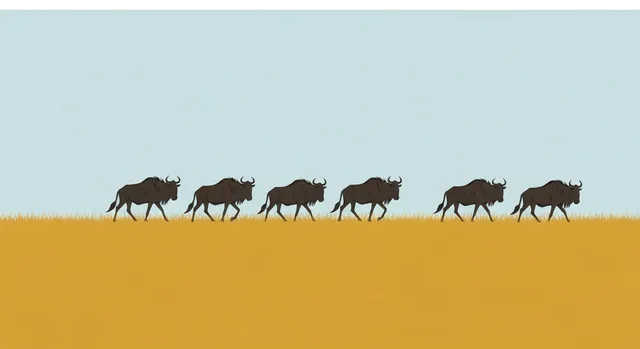
The engine of the Great Migration
Everything spectacular about the Serengeti — the river crossings, the calving, the predators that follow — is ultimately powered by two unglamorous-looking grazers: the wildebeest and the zebra. Around 1.5 million wildebeest, together with several hundred thousand zebra and a supporting cast of gazelle, loop clockwise through the Serengeti–Mara ecosystem every year in search of grass and water. It is the largest overland migration of animals anywhere on the planet, and standing inside a herd that stretches unbroken to the horizon, the air full of the wildebeest's strange nasal grunting, is one of the great experiences in nature.
It helps to see the migration not as an event but as a continuous, year-round movement that is always somewhere. The herds calve in the south, drift west and north as the plains dry, gamble across the rivers, then turn back south as the short rains break — a loop that repeats, with the timing shifting by a couple of weeks each year according to the rains. The wildebeest and zebra are the constant; the crossings and calving are simply the chapters of their year that draw the crowds. Understand these two animals and you understand the whole spectacle.
Why wildebeest and zebra travel together
One of the quiet wonders of the migration is that two different species choose to move as one, and they do it because the partnership pays. Their senses complement each other: zebra are widely held to have sharper eyesight, while wildebeest are credited with a keener sense of smell and hearing — so a mixed herd has more ways to detect a lurking predator than either species alone. Mixed herds are simply harder to ambush, and both animals benefit from the shared vigilance and the sheer safety of numbers.
They even feed in a way that suits them both. Zebra are bulk grazers that crop the taller, coarser top growth of the grass, and in doing so they expose the shorter, more nutritious leaves underneath that wildebeest prefer — so where zebra have grazed, wildebeest follow. This grazing succession lets the two species share the same ground without directly competing for the same bite, and it's part of why the columns you see on the move so often mix black-and-white stripes with dark wildebeest flanks. Far from coincidental travelling companions, they are an ecological double act that makes the whole migration more resilient.
- Complementary senses: zebra are reputed to see well, wildebeest to smell and hear well — together they spot danger sooner.
- Safety in mixed numbers: a combined herd is harder for predators to ambush.
- Grazing succession: zebra crop the tall coarse grass, exposing the shorter, richer growth wildebeest favour.
- The result: black-and-white stripes threaded through dark wildebeest columns all along the loop.

Calving: half a million born in three weeks
The migration's most concentrated burst of life happens at the start of the year on the southern short-grass plains around Ndutu, on the edge of the Ngorongoro highlands. Calving peaks around February, when roughly half a million wildebeest calves are born in a window of about three weeks — an extraordinary synchrony that floods the plains with newborns far faster than predators can possibly take them. The herds gather here because the open ground lets them see danger coming and the mineral-rich, volcanic-ash grass fuels lactating mothers. A wildebeest calf is on its feet within minutes and running with the herd within hours, a head start it absolutely needs.
For visitors, calving season is the most intense wildlife theatre of the year. The sheer density of vulnerable young draws lions, cheetahs, hyenas and jackals in numbers, and the open, treeless plains mean you can watch the drama unfold in the clear — this is the prime window for seeing cheetahs hunt. It is tender and brutal in equal measure, and unforgettable either way. As always, treat 'February' as a long-run average rather than a fixed date: the rains that green the southern plains, and so trigger the gathering, can run early or late.
- Where: the southern short-grass plains around Ndutu, on the Ngorongoro edge.
- When: peaks around February — but verify, as rains can shift it by a fortnight either way.
- Scale: roughly half a million calves in about three weeks, swamping the predators.
- Viewing: the year's most intense predator action, and the best window for open-plain cheetah hunts.
The river crossings and the journey north
As the southern plains dry through the middle of the year, the herds drift west through the Grumeti country and then north towards the Mara River, the migration's most famous and most dangerous test. From about July, columns of wildebeest and zebra pile up on the banks in the far north around Kogatende, hesitate, and then pour across the crocodile-dark water in a churning, dust-choked rush — the single most cinematic hour the Serengeti offers, and the hardest to time. Peak drama is usually August, with crossings continuing into September and October as the herds move back and forth across the Kenyan border.
The honest truth is that no one can schedule a crossing. The herds cross when their collective nerve breaks, which might be at dawn or not at all on a given day, governed by grazing, weather and instinct rather than any timetable. The way to weight the odds in your favour is to base yourself in the north for several nights during the dry-season window, travel with a patient guide, and accept that the waiting is the experience. Zebra are full participants here too — often among the first to commit to the water — and the crossing is very much a mixed-species gamble, not a wildebeest-only affair.
- Where: the Mara River in the far north, around Kogatende.
- When: mainly July to October, with peak drama usually in August — verify for your dates.
- No guarantees: crossings hinge on weather, grazing and the herds' nerve, never a schedule.
- Best odds: several nights in the north during the dry season, with a patient guide.
An at-a-glance migration card
A quick orientation to the year. The wildebeest and zebra are always somewhere in the ecosystem — the question is which chapter you want to stand inside. Pick the event first, then the month, then the sector, and treat every date as an average the rains can move.
- Cast: ~1.5 million wildebeest plus several hundred thousand zebra and gazelle.
- Partnership: zebra and wildebeest travel together for shared vigilance and complementary grazing.
- Calving: peaks ~February on the southern Ndutu plains.
- Drift: west through the Grumeti, then north, as the southern plains dry.
- Crossings: mainly July–October on the Mara River around Kogatende, peaking ~August.
- Return: herds turn back south as the short rains break, usually around November.
- Verify: all timing is a 30-year average — check the live picture for your exact dates before booking.
Related guides

The Great Migration in the Serengeti
How the Great Migration actually works — the year-round clockwise loop through the Serengeti–Mara ecosystem, why the rains run the show, where the herds usually move month to month, and how to plan a safari around it without pretending nature is on a timetable.
Read guide
Calving Season in the Serengeti (Ndutu)
Calving season on the southern Serengeti plains around Ndutu — when roughly half a million wildebeest are born in about three weeks, why it draws the densest predator action of the year, and how to plan a green-season safari around it.
Read guide
Mara River Crossings in the Serengeti
How to plan a Northern Serengeti river-crossing safari without false promises — when the Mara crossings happen at Kogatende, why timing is luck, where to stay, and how to watch with good wildlife etiquette.
Read guideMore in Wildlife
6
Big Cats in the Serengeti
A guide to the Serengeti's three great cats — lion, cheetah and leopard — where each is most likely, how their behaviour shapes a sighting, and why a patient vehicle and a good guide matter more than any guarantee.
Read guide
Birdwatching in the Serengeti
A traveller's guide to birding the Serengeti — the rollers, ostriches, raptors and wet-season migrants that fill the plains — and how to add birdwatching to a safari without losing the mammal focus.
Read guide
Black Rhino in the Serengeti
Honest expectations for seeing black rhino in the Serengeti — why sightings are rare, where the small protected population lives around the Moru Kopjes, and why the Ngorongoro Crater is often the better add-on for rhino.
Read guide
Buffalo in the Serengeti
Cape buffalo in the Serengeti — herd behaviour, the long rivalry with lions, why solitary old bulls demand respect, and why buffalo deserve more than a quick tick on the Big Five checklist.
Read guide
Camera Gear for a Serengeti Safari
A practical packing guide to camera gear for a Serengeti safari — lenses and bodies, batteries and cards, the all-important bean bag, dust protection, your phone, binoculars and how to pack it all for strict light-aircraft limits.
Read guide
Crocodiles in the Serengeti
Where the Serengeti's Nile crocodiles live, the role they play in the Grumeti and Mara River crossings, and how to watch the drama responsibly — with honest, no-guarantee expectations.
Read guide