
Serengeti in June
June in the Serengeti is the threshold of the dry season — the long rains let go, the tracks firm up, and the migration spills west along the Grumeti. Quieter than the famous months, with the year's first real river drama.

Photo: Helena Pfisterer / Unsplash
- ✓June is the start of the long dry season: skies clear, the bush begins to thin, and roads that were heavy in May firm up fast.
- ✓On a 30-year average the herds are moving through the central Serengeti into the Western Corridor, drawn toward the Grumeti River — though timing swings a fortnight either way, so verify for your exact dates.
- ✓The Grumeti can produce the season's first crossings, smaller and less predictable than the Mara drama but with resident crocodiles waiting all the same.
- ✓Demand and rates climb through the month as peak season opens; June still sits a notch below the July–September crush, which is its quiet advantage.
- ✓Cool, dry mornings and comfortable afternoons make for some of the most pleasant game-driving weather of the year.
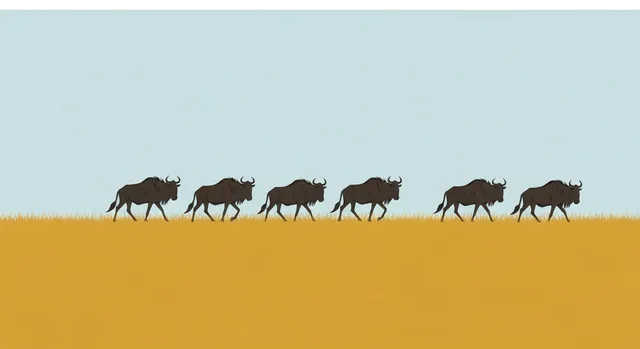
The month the Serengeti exhales
June is a turning point. The long rains of April and May taper off, the grass that grew waist-high begins to gold and thin, and the whole ecosystem seems to exhale into the long dry season. Standing water shrinks back toward the permanent rivers, and with it the wildlife starts to concentrate — the first sign of the easy, generous game viewing that the dry months are famous for.
It is, in many ways, the connoisseur's month. The landscape still carries a memory of green, the dramatic build-up of cloud has mostly passed, and the great wave of peak-season travellers has not yet fully arrived. You get clearing skies and firming roads without the full weight of July and August prices and vehicles. For a first safari that wants both atmosphere and value, June is a quietly brilliant choice.
Where the herds usually are in June
Treat the migration as a clockwise loop driven by rain, not a timetable. By June the herds have generally left the southern Ndutu calving grounds behind and are pushing through the central Seronera plains into the Western Corridor, following the receding grazing toward the Grumeti River. This is the migration's first real test of the season — the Grumeti is narrower and less notorious than the Mara, but it holds some of the largest crocodiles in Africa, and the crossings here can be sudden and dramatic.
The honest caveat matters: these positions are 30-year averages. A late, heavy rainy season can hold the herds further south into early June; a dry one can hurry them west. Never book a June trip on the assumption of a Grumeti crossing on a particular day — base yourself well, give yourself nights rather than hours, and treat any crossing as a gift rather than a guarantee. Verify the current position with your operator close to departure.
- Most likely sector: central Serengeti through to the Western Corridor and Grumeti.
- Possible event: early-season Grumeti River crossings — unpredictable, never schedulable.
- Resident wildlife around Seronera stays put regardless of where the herds roam.

Weather, roads and what to pack
June weather is among the kindest the Serengeti offers. Mornings on the plains are genuinely cold — a fleece and a windproof layer for the open vehicle at dawn are not optional — but the days warm to comfortable, dry and bright, and the humidity of the green season is gone. Rain is possible early in the month as the long rains bow out, but by late June it is increasingly rare.
On the ground, the firming roads are part of June's appeal. The black-cotton soils that turn to glue in the wet are drying out, opening up tracks that were slow or impassable in May. That said, the Western Corridor can stay damp longest, so a capable guide and a 4x4 still earn their keep. Pack layers, neutral colours, sun protection for the high-altitude light, and a good zoom lens for the cats that gather near shrinking water.
Which region and camp to base in
June is a following month, so where you sleep should track the herds' likely westward push. On the long-run average the natural bases are the central Serengeti around Seronera and the Western Corridor toward the Grumeti River. A central Seronera lodge is the dependable all-rounder: it sits among some of the park's densest resident big-cat country, so even on a quiet migration day you have lions, leopards and cheetahs close by, and it keeps you within reach of the herds as they move. A Western Corridor camp, by contrast, places you nearer the Grumeti and the season's first possible crossings — the bolder choice if river drama is the draw, with the trade-off that the corridor's black-cotton tracks can stay damp longest into early June.
Camp style matters as much as location. A mobile or seasonal camp that moves with the migration puts you closest to wherever the herds happen to be, which is the surest way to follow an unpredictable spectacle; a permanent lodge offers more comfort and reliable resident game as insurance against a slow crossing day. Because June still sits a notch below the July–September crush, you have more choice and a little more value than in the headline months, but the better corridor camps still reward booking ahead. Whatever you choose, give yourself several nights in one strong sector rather than spreading thin — the herds reward patience, not mileage.
- Central Seronera: dependable resident big cats plus reach toward the moving herds.
- Western Corridor: closest to the Grumeti and the season's first possible crossings.
- Mobile/seasonal camp: moves with the migration — best for following the herds.
- Permanent lodge: more comfort and reliable resident game as a quiet-day insurance.
- Corridor tracks can stay damp early in June — a capable guide and 4x4 still earn their keep.
Who June suits — and what to manage
June is a connoisseur's month that suits a particular kind of traveller especially well. It rewards first-timers who want fine weather, fewer vehicles and real value over a guaranteed headline crossing; photographers who prize the kind, golden early-dry-season light and the cats gathering near shrinking water; and anyone who would rather have a kopje or a riverbank closer to themselves than share the famous northern viewpoints with a line of vehicles. The game viewing is already strengthening as standing water shrinks and wildlife concentrates, so general sightings are reliably good even before the migration's headline drama arrives.
What to manage is expectation, not the experience. If your heart is set specifically on dense Mara River crossings, June is the wrong month — that spectacle belongs to the far north from roughly July to October, and the Grumeti crossings June can offer are smaller, less predictable and never schedulable. Frame any crossing as a possible gift, not a plan. Mornings on the plains are genuinely cold, so pack warm layers for the open vehicle. And as always with money and access, keep park fees, gate hours and conservation charges to current official sources — Tanzania National Parks (TANAPA) and your operator — rather than fixed figures that date quickly. Choose June for weather, value and a quieter park; verify the live herd position close to departure.
- Best for: value-minded first-timers, light-chasing photographers and quiet-seekers.
- Manage: June is not a reliable Mara-crossing month — that is the north, Jul–Oct.
- Grumeti crossings are smaller, patchier and never schedulable — treat them as a bonus.
- Cold dawns: pack genuinely warm layers for early game drives.
- Check current fees and gate hours with TANAPA and your operator, not fixed quotes.
Planning a June safari
Because June straddles the shoulder and the start of peak season, it rewards early planning without demanding the absolute year-ahead booking that August does. Camps in the Western Corridor and central Serengeti are the natural bases for following the herds west; a mobile camp that moves with the migration puts you closest to the Grumeti, while a permanent Seronera lodge gives you reliable resident big cats as insurance against a quiet crossing day.
If your heart is set specifically on river crossings, weigh June against the later northern months — the Mara crossings around Kogatende are a surer bet in August and September. But if you want fine weather, opening-season value, fewer vehicles and a genuine chance at the first crossings of the year, June is a sweet spot. Pair it with the Ngorongoro Crater and Tarangire on the drive in from Arusha for a fuller Northern Circuit.
Related guides

The Grumeti River Migration
The migration's first water test: Western Corridor timing, the Grumeti River's giant crocodiles, where to base yourself, and why a Grumeti crossing is a quieter, less predictable affair than the famous Mara.
Read guide
Western Corridor of the Serengeti
The Western Corridor is the Serengeti's long western arm reaching toward Lake Victoria — Grumeti River country, the migration's first water test, giant crocodiles and quieter, lower-crowd camps. When the west is worth the detour, and when it is not.
Read guide
Serengeti Dry Season Safari
What the dry season means for a Serengeti safari — the famous Mara River crossings, the easiest game viewing of the year as wildlife concentrates around water, plus the realities of dust, crowds, premium prices and early-booking camps.
Read guideMore in When to Go
6
Best Months for Serengeti Photography
Which Serengeti months deliver the photographs you want — dramatic light and dust, emerald plains, newborns, river crossings, big cats and fewer vehicles in your frame.
Read guide
Calving Season in the Serengeti
Calving season on the southern Serengeti plains around Ndutu — when roughly half a million wildebeest are born in about three weeks, why it draws the densest predator action of the year, and how to plan a green-season safari around it.
Read guide
Calving Season in the Serengeti (Ndutu)
Calving season on the southern Serengeti plains around Ndutu — when roughly half a million wildebeest are born in about three weeks, why it draws the densest predator action of the year, and how to plan a green-season safari around it.
Read guide
Calving Season vs River Crossings
Two faces of the Great Migration: the southern Ndutu calving in the green months, and the northern Mara crossings in the dry. Decide between them by wildlife, budget, crowds, predictability and the kind of drama you want.
Read guide
Christmas & New Year in the Serengeti
How to plan a Christmas or New Year safari in the Serengeti — green December plains, gathering herds, premium festive camps, family-friendly logistics and the flights that make a holiday trip work. Romantic, festive and worth booking early.
Read guide
Great Migration Planning Mistakes
The planning mistakes that make travellers miss the herds, overspend, or book the wrong Serengeti sector — and how to avoid each one so your dates, your camp and the migration actually line up.
Read guide