
Southern Serengeti Plains Guide
The southern Serengeti plains are the open, treeless short-grass country on the Ngorongoro edge — the migration's calving grounds and the park's most cinematic emptiness. A guide to planning the southern plains: the seasonal herds, calving, the predators that follow, mobile camps and Ndutu-adjacent safari days.

Photo: Matteo Di Iorio / Unsplash
- ✓The southern plains are open, treeless short-grass country fed by volcanic ash — the richest grazing in the ecosystem and the migration's calving grounds.
- ✓They are seasonal: the herds gather here in the green months, roughly December to March, then move on as the plains dry out.
- ✓Calving season — peaking around February — brings around half a million births in a few weeks and the most intense predator action of the year.
- ✓The open ground makes this the best country for watching cheetahs hunt in the clear.
- ✓Mobile camps that follow the herds, plus the Ndutu-adjacent area on the Ngorongoro edge, are the natural way to stay; treat all timing as a 30-year average and verify your dates.
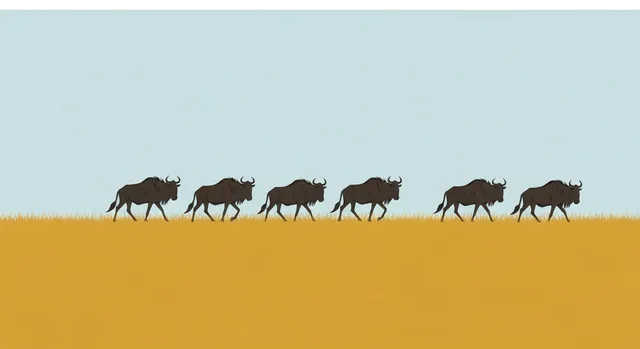
The endless short-grass plains
The southern Serengeti is the landscape the park's name conjures — the Maasai word siringet, the place where the land runs on forever. Down here, on the edge of the Ngorongoro Conservation Area, the woodland of the central park gives way to vast, flat, treeless short-grass plains that stretch unbroken to the horizon. It is the most cinematic emptiness in the Serengeti: a sea of grass under an enormous sky, broken only by the odd granite kopje, a lone acacia and the faint blue line of the highlands to the south.
That emptiness is deceptive, because this is the most fertile ground in the whole ecosystem. The plains are blanketed in fine volcanic ash from the Ngorongoro highlands, which over millennia has created mineral-rich, short-cropped grassland — the best grazing in the Serengeti. It is exactly this nutrition that draws the migration here every year to give birth, and it is why the southern plains, for a few months at a time, hold the densest concentration of wildlife the park ever sees.
But the southern plains are seasonal. Unlike the resident-cat country of central Seronera, this is open ground with little permanent water, and once the rains stop and the grass dries, the herds — and much of the action — move on. Understanding that rhythm is the key to planning a southern-plains safari well.
A seasonal landscape: when the plains come alive
The southern plains live and die by the rains. From around December, the short rains green the grass and the migration pours down from the central and western Serengeti to graze and, ultimately, to calve. Through roughly January to March, in a normal year, this is where the herds are — hundreds of thousands of wildebeest and zebra spread across the plains in a spectacle of sheer numbers, with the calving grounds around the Ndutu area as the focal point.
As the long rains build and then the plains begin to dry from around April and May, the herds start their long move north and west, following the greening grass and the promise of water. By the dry season, roughly June to October, the southern plains are largely empty — beautiful, but quiet, with the resident game thin and the migration far away in the centre and north. This is the inverse of central Seronera: the south is at its best precisely when the rest of the park is in its green low season.
The practical lesson is to plan around the calendar. If you want the southern plains in their full glory — herds, calving and predators — you are looking at the green months, roughly December to March. Outside that window the area is a different, quieter place. As always, treat these months as a long-term average; the rains can arrive or fail a couple of weeks early or late, and the herds move with them, so verify the likely picture for your exact dates close to travel.
- December–March (green months): herds gather and calve; the plains at their fullest.
- Around February: peak calving, the densest wildlife the south ever holds.
- April–May: herds move north and west as the plains begin to dry.
- June–October (dry season): the south is largely empty — quiet and beautiful, but not for the herds.
Calving and the predators that follow
The reason the herds choose these plains is to give birth, and calving is the southern Serengeti's great set piece. In a window of roughly three weeks, peaking around February, somewhere near half a million wildebeest calves are born on the short grass. The herds gather here because the open ground lets them see predators coming and the mineral-rich new grass fuels lactating mothers — a strategy of safety in numbers and good nutrition, played out on a colossal scale.
Where there are vulnerable newborns, predators follow. Calving season brings the most intense predator action of the Serengeti year: lions and hyenas work the edges of the herds, and the open, treeless plains give cheetahs the clear ground and long sightlines they need to hunt in the open. For visitors, this is a raw, unforgettable study of life and death on the plain — and statistically the best window the park offers for watching big cats hunt. The southern plains are, for these few weeks, the most dramatic place in the Serengeti.
- Calving peaks around February — roughly half a million births in about three weeks.
- Open ground gives the herds early warning and lets cheetahs hunt in the clear.
- Lions, hyenas and cheetahs concentrate on the calving grounds — the year's most intense predator viewing.
- It is raw and unsentimental — predation is constant and visible.
How to stay: mobile camps and Ndutu-adjacent days
Because the southern plains are seasonal, the natural way to stay is in mobile or seasonal camps that set up here for the green months and move on when the herds do. These tented camps follow the action, positioning themselves close to the calving grounds during the peak window, and then packing up and migrating with the herds — putting you nearer the day's wildlife than any permanent lodge could. For the calving season especially, a well-placed mobile camp is the classic, and often the best, choice.
The focal point for southern-plains stays is the Ndutu area, on the southern edge of the ecosystem where the Serengeti meets the Ngorongoro Conservation Area. Ndutu sits at the heart of the calving grounds and is the most established base for green-season safaris in the south, with its own cluster of camps. It is worth knowing that part of the Ndutu area lies outside Serengeti National Park, within the Ngorongoro Conservation Area, which carries its own rules and fees — a useful logistical detail to verify when planning. A southern-plains itinerary built around Ndutu-adjacent days gives you the calving grounds, the open-plains predators and easy combination with the Ngorongoro Crater on the way in or out.
Rates and park and conservation fees change, so do not anchor to fixed figures — verify current numbers with operators and official Tanzania National Parks (TANAPA) and Ngorongoro Conservation Area sources close to travel. The principle to plan around is the same across the Serengeti: timing and placement drive cost more than luxury labels, and the green-season south can offer real value alongside its spectacle.
Related guides

Southern Serengeti Migration Guide
When the southern Serengeti plains and Ndutu make sense for the Great Migration — the green-season calving window, the predators it draws, and how to plan a mobile-camp safari around the herds. An honest, evergreen guide to migration timing in the south.
Read guide
Ndutu Safari Guide
Everything to know before a Ndutu safari — the calving heartland on the southern Serengeti edge, why it sits in the Ngorongoro Conservation Area rather than the national park, its off-road and fee implications, the best season, where to stay and how it fits a wider itinerary.
Read guide
Mobile Camps in the Serengeti
How seasonal mobile camps follow the migration around the Serengeti, what staying in one is really like, and who should choose canvas-that-moves over a permanent lodge.
Read guideMore in Park Areas
6
Best Serengeti Area for a First Safari
A first-timer's decision guide to the Serengeti's sectors — central Seronera, the southern plains, the Western Corridor and the far north — chosen by month, budget and what you most want to see, with the honest trade-offs.
Read guide
Eastern Serengeti Guide
A guide to the eastern Serengeti — the wide-open, kopje-dotted plains east of Seronera, why they are some of the best cheetah country in the park, the low vehicle density that defines them, and when the eastern side is worth it.
Read guide
Grumeti: The Western Serengeti's River Country
A guide to Grumeti — the river, the wildlife and the exclusive private concessions on the Serengeti's western edge. Migration timing in the western ecosystem, giant crocodiles, and the luxury camps that draw travellers to this quiet corner.
Read guide
Ikoma & Fort Ikoma: Edge-of-Park Value in the Western Serengeti
A guide to the Ikoma area and Fort Ikoma on the western edge of the Serengeti — gateway to the Western Corridor, with drive-in access, budget-friendly stays in the Ikoma Wildlife Management Area, night-drive options and honest caveats.
Read guide
Moru Kopjes Guide
A guide to the Moru Kopjes in the central-southern Serengeti — the dramatic granite outcrops famous for lions and rock art, one of the park's last rhino strongholds, and how Moru fits a central-southern game drive.
Read guide
Namiri Plains Guide
A guide to Namiri Plains in the eastern Serengeti — the open, kopje-dotted cheetah country east of Seronera, why it is one of Africa's great predator landscapes, how camps are positioned, and who should go east.
Read guide