
Serengeti Safari FAQ
Straight, practical answers to the questions travellers ask most about a Serengeti safari — timing, the migration, camps, costs, flights, safety, children, photography and how to combine the park with the rest of Tanzania.

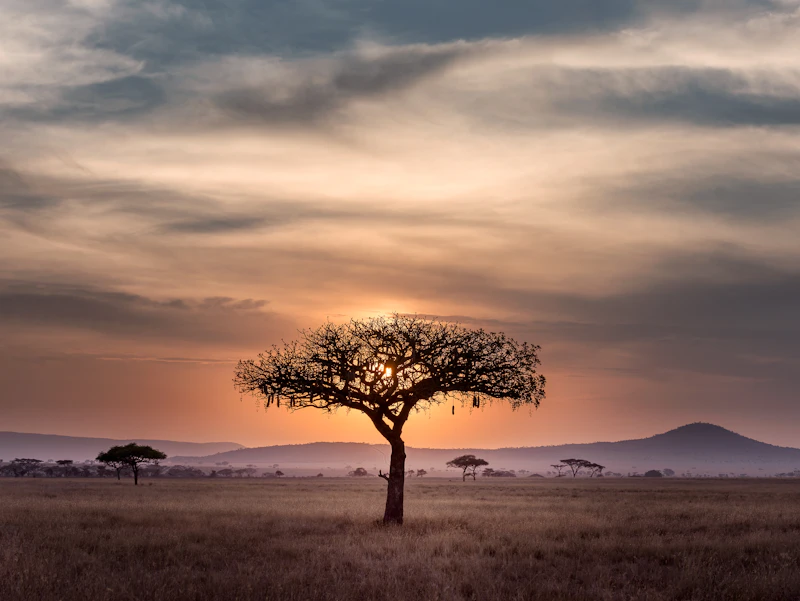
Photo: Denice Alex / Unsplash
- ✓There is no single best month — match your dates to the event you want: calving early in the year, the northern river crossings in the dry season, or quiet, green-season value.
- ✓Plan on three to four nights in the park as a sensible minimum; a week lets you combine sectors or add Ngorongoro and Tarangire.
- ✓Park, concession and conservation fees are fixed and charged per person per day — verify current amounts via official sources rather than any figure quoted online.
- ✓The Serengeti, with a reputable operator, is a remarkably safe holiday; the wildlife is the spectacle, not the danger, when you follow your guide.
- ✓Fly-in saves long road hours and suits the remote north; drive-in costs less and folds in the rest of the Northern Circuit.
Timing & the migration
When is the best time to visit the Serengeti? There is no single best month — the right time is the one that matches what you most want to witness. The dry season from roughly mid-year brings clear skies, easy game viewing and the famous northern river crossings, but also the crowds and the highest rates. The start of the year brings calving on the southern plains and the most intense predator action of the year. The green low season of the long rains is lush, dramatic, quiet and far better value. Treat all migration timing as a long-term, 30-year average to verify against current conditions, never a fixed calendar.
Where is the migration right now? The herds loop clockwise through the ecosystem year-round, so they are always somewhere — roughly, calving on the southern Ndutu plains early in the year, pressing west through the Grumeti country mid-year, gathering for the Mara crossings in the far north through the dry months, then turning south again as the short rains break. Because they follow the rains, timing shifts year to year; always check where the herds usually are for your exact dates before booking a camp.
Can I guarantee seeing a river crossing? No — and be wary of anyone who promises one. Crossings cluster in the dry-season window around the Kogatende sector in the north, but the day and hour depend on weather, grazing, river levels and the herds' nerve. Give yourself several nights in the north during the window and a patient guide, and accept that the waiting is part of the experience.
- No single 'best' month — pick the event (calving, crossings, green-season value), then the dates.
- The migration is a year-round clockwise loop; verify where the herds usually are for your exact dates.
- River crossings can never be guaranteed — base in the north for several nights to improve the odds.
Length, camps & cost
How many days do I need in the Serengeti? Three to four nights inside the park is a sensible minimum — enough to settle into the rhythm of dawn and late-afternoon drives and to give the wildlife time to appear. A week lets you combine two sectors, or fold in the Ngorongoro Crater and Tarangire on a drive-in itinerary. A single rushed night after a long overland drive means more road than wildlife and is rarely worth the fixed fees.
What kind of camp should I book? Camp placement matters as much as camp quality — the best lodge in the wrong sector misses the action. There are three broad styles: permanent lodges, reliable and central and good for a first safari; classic tented camps for atmosphere; and mobile camps that pack up and follow the herds, which put you closest to the crossings or the calving. Choose the sector your dates point to first, then weigh style and budget, and always verify a camp's location against the migration for your exact dates.
How much does a Serengeti safari cost? The biggest levers are camp style, whether your vehicle is private or shared, and whether you fly or drive. On top of accommodation and transport sits a fixed floor of park, concession and conservation fees, charged per person per day and identical for everyone — these change over time and should be checked against official sources, never a figure quoted online. Peak dry-season dates in the north command the highest rates and book out earliest. A budget is very achievable through shared vehicles, simpler camps, driving rather than flying, and green-season timing.
- Plan three to four nights minimum; a week allows combining sectors or adding Ngorongoro and Tarangire.
- Choose the sector first, then the camp style — lodge, classic tented or mobile — and verify placement for your dates.
- Fixed fees apply to everyone; the variable costs are camp style, private-or-shared vehicle, and fly-or-drive.
Getting there, safety, kids & photography
Should I fly in or drive in? Both work. Drive-in safaris from Arusha cost less, show you the country roll past, and combine easily with Ngorongoro and Tarangire — at the price of long days on rough roads. Fly-in safaris hop between bush airstrips, saving hours and making the remote north practical on shorter trips, at a higher cost. Most trips start at Kilimanjaro International Airport, with Arusha as the gateway town; light aircraft connect Arusha and even Zanzibar with airstrips at Seronera, Kogatende and Ndutu. Note that bush flights have strict soft-bag-only baggage and weight limits.
Is a Serengeti safari safe? Run by a reputable operator, it is a remarkably safe holiday — the wildlife is the spectacle, not the danger, when you follow your guide. The core rules are simple: stay in the vehicle, stay calm and quiet, and do as your guide says, because animals read a vehicle as a single harmless shape. Camps are unfenced by design, so after dark you are escorted between your tent and the mess. Plan realistic health precautions — malaria prevention, sun, heat, hydration and tsetse flies — with a travel clinic before you go.
Can I bring children, and what about photography? Many camps welcome families, but minimum ages and game-drive suitability vary, so check policies before booking a family trip. For photographers, the open plains and exceptional light are a gift; the dry season's thin bush and concentrated wildlife, and the open calving plains for cats in the clear, are especially rewarding. A private vehicle pays off here — it lets you linger at a sighting and position for the light on your own schedule. Whatever you photograph, sightings are always wild luck weighted by time, sector and a good guide.
- Fly-in saves time and suits the north; drive-in costs less and combines with the wider circuit.
- With a reputable operator the Serengeti is very safe — stay in the vehicle, follow your guide, plan health precautions.
- Children are welcome at many camps with age limits; photographers benefit most from a private vehicle and good light.
Combining the Serengeti with the rest of Tanzania
What should I pair the Serengeti with? Few people fly to Tanzania for the Serengeti alone. The classic Northern Circuit strings it together with the Ngorongoro Crater — a self-contained, wildlife-packed caldera that lies on the road in from Arusha and is the most reliable place on the circuit to see black rhino. Tarangire, famous for elephants and baobabs, and Lake Manyara, with its flamingos and tree-climbing lions, add variety on the drive in. Many travellers finish on the white sand of Zanzibar, an easy flight away, to decompress; the more ambitious add a Kilimanjaro climb before or after the safari.
How do I sequence it all? On a drive-in trip, the natural order runs Arusha to Tarangire or Lake Manyara, up to the Ngorongoro Crater for a morning on the floor, then on to the Serengeti, with the herds' position for your dates deciding which sector you finish in. A fly-in trip can do the reverse — bush flights straight to a northern or southern camp — and still pick up the Crater on the way out. Whichever shape you choose, build the route around the migration calendar rather than a fixed loop, and let the season decide the order.
- Most trips pair the Serengeti with the Ngorongoro Crater; Tarangire and Lake Manyara add variety on the drive.
- Zanzibar is the classic beach finish, an easy flight away; Kilimanjaro suits the more ambitious.
- Sequence the route around the migration calendar and your sector, not a fixed loop.

Related guides
Best Time to Visit the Serengeti
The best time to visit the Serengeti depends on the event you most want to witness. Match the month to the migration — calving, river crossings or big-cat hunting — and build the rest of the trip around the herds, the weather, the crowds and your budget.
Read guide
How Much a Serengeti Safari Costs
What a Serengeti safari really costs — the building blocks of park fees, accommodation, vehicles, flights and guiding, how season, sector and style move the total, and how to build a realistic per-person, per-day budget without quoting figures that go stale.
Read guide
How to Get to the Serengeti
The hub for getting to the Serengeti — flying into Kilimanjaro or Arusha, the choice between a bush flight and the overland drive, the airstrips and park gates, plus the visa and packing basics that shape every route.
Read guideMore in Getting There
6
Accessible Serengeti Safari Planning
How to plan an accessible Serengeti safari — adapted vehicles and transfers, level camps and bathrooms, airstrip and fly-in considerations, medical support and evacuation, and why a private, tailored trip is usually the key to travelling well with mobility or other needs.
Read guide
Arusha to the Serengeti
How to get from Arusha to the Serengeti — the overland drive through Ngorongoro, the light-aircraft fly-in, and the overnight-routing options — with the time, comfort and cost trade-offs of each.
Read guide
Bush Flight Luggage Rules for the Serengeti
How luggage works on a Serengeti safari — the strict soft-bag and weight rules for light bush aircraft, what counts toward your allowance, how to pack camera gear, and how the same bags ride in a safari vehicle.
Read guide
Driving to the Serengeti: Roads, Timing and the Long-Haul Reality
What driving to the Serengeti is really like — the road route from Arusha through Ngorongoro, gate timing, road conditions in the dry and the rains, vehicle choice, and why nearly everyone travels with an operator rather than self-driving.
Read guide
Drone Rules in the Serengeti: Why They're Restricted and What to Do Instead
Why drones are restricted in the Serengeti, why general visitors should not assume they can fly one, what a permit would realistically involve, and the better ways to capture sweeping aerial-style images of the plains — from a balloon flight to a long lens.
Read guide
Food & Drink on a Serengeti Safari
What eating and drinking on a Serengeti safari is really like — camp meals from budget to ultra-luxury, bush breakfasts and picnic lunches, sundowners and the bar, drinking water, and how camps handle dietary needs, allergies and children.
Read guide