
Private Serengeti Safari
When a private vehicle and guide are worth it on a Serengeti safari — for timing, photography, families, flexibility and tracking the migration — and how a private trip differs from a shared one.

- ✓A private safari means a vehicle and guide dedicated to your party — the day flexes to you rather than to a shared schedule.
- ✓The case is strongest for photographers, families with young children, special-occasion travellers, and anyone chasing the migration, where flexibility pays off most.
- ✓Private guiding lets you leave before dawn, linger at a leopard for hours and reshape the plan around a sighting or a crossing.
- ✓Private does not have to mean ultra-luxury — you can run a private vehicle with mid-range lodges and still gain the flexibility.
- ✓Treat migration timing as a 30-year average and verify camp placement for your dates; a private vehicle helps you adapt, but it cannot move the herds.
What a private safari actually is
A private Serengeti safari simply means the vehicle and the guide are yours alone, rather than shared with strangers on a fixed itinerary. It is a different thing from luxury, though the two often travel together: you can run a private vehicle alongside comfortable mid-range lodges, and you can stay in a grand camp on a shared vehicle. What you are buying with the word private is control — over the pace of the day, the route, the early starts and late finishes, and the hundred small decisions that add up to a trip shaped around you.
On a shared, or group-joining, safari you travel with others to keep the cost down, which works beautifully for many people. The difference appears at the margins: when you want to wait an extra hour at a sighting and a fellow passenger wants lunch, when you would happily skip breakfast to be at the kopje for the lions at dawn, or when a river crossing looks likely and you want to commit the whole morning to it. On a private trip those calls are yours. On a shared one they are a negotiation.
At a glance
A quick orientation before the detail. Keep vehicle-rate, park-fee and lodge figures to your operator and official sources — they change, and this page stays evergreen on purpose.
- Best for: photographers, families with young children, honeymooners and special-occasion travellers, birders and special-interest trips, and anyone tracking the migration.
- Core benefit: a vehicle and guide dedicated to your party, so the day's pace, route and timing flex to you.
- Not the same as luxury: you can pair a private vehicle with mid-range lodges and still gain the flexibility.
- Best paired with: a strong private guide — the single upgrade most repeat travellers say they would never give up.
- Trade-off: a private vehicle costs more per person than a shared seat, and the gap shrinks as your party grows.
- Always verify: migration timing is a 30-year average — a private vehicle helps you adapt, but confirm camp placement for your dates.
When private is genuinely worth it
Some travellers gain far more from a private vehicle than others. Photographers benefit most of all: the freedom to position the vehicle for the light, to wait out a sighting without a fellow passenger's patience running thin, and to fill the seats with gear rather than people is the difference between snapshots and a portfolio. Families with young children gain comfort and sanity — flexible meal and rest timing, no awkwardness over a toddler's mood, and a guide who can pitch the day to the children's attention span.
Special-occasion travellers — honeymooners, anniversaries, a milestone birthday — buy intimacy and the freedom to make the trip entirely their own. Birders and special-interest travellers can have the whole itinerary bent around a passion, with a specialist guide who knows where to look. And anyone serious about the migration gains the most precious thing of all: the ability to commit a whole morning to a possible crossing, or to relocate the day's plan when the herds shift. If none of these describe you, a shared safari may serve you just as well for less.
The guide is the upgrade
It is easy to focus on the vehicle and forget that the guide is what you are really buying. A private safari lets you travel with one guide for the whole trip — someone who learns what you love, reads the plain, anticipates behaviour and tells the deeper story of the ecosystem rather than ticking species off a list. Continuity matters: by day three a good private guide knows you want big cats and dramatic light, and the safari quietly tunes itself to that.
At this level you can also request a specialist — a big-cat tracker, a birder, a walking guide — and have the days shaped around an interest. The best guides turn a sequence of sightings into a narrative, explaining why the cheetah favours the open plains, how the lions divide the kopje, what the vultures circling on the horizon mean. When repeat travellers are asked what they would never give up, the private guide, more than the suite or the aircraft, is the answer.
Flexibility, timing and tracking the migration
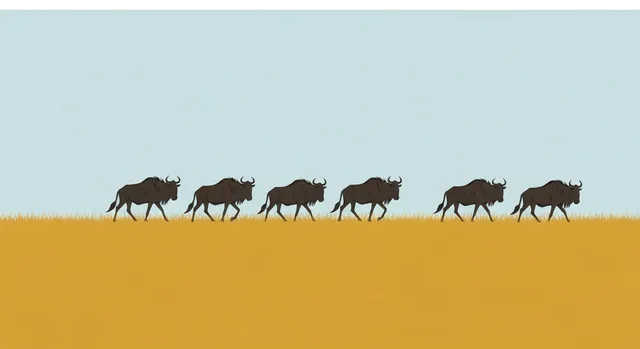
The migration is a clockwise loop that follows the rain, not a schedule, and that unpredictability is exactly where a private vehicle earns its keep. When a crossing looks likely in the far north, you can dedicate the whole morning to the river instead of breaking for a fixed lunch. When the herds shift a sector earlier or later than the long-term average, you and your guide can rethink the day rather than be locked to a shared plan. The control does not move the herds — nothing does — but it lets you respond to them.
Be honest with yourself about what flexibility can and cannot do. A private safari helps you adapt to the migration; it cannot guarantee a crossing or summon the herds to your camp. The decisive factor remains where you base yourself: verify, for your exact dates, where the herds are likely to be and that your camp is placed for it. Build the route around the season first, then let the private vehicle handle the day-to-day improvisation that turns a good safari into a great one.
Cost, group size and how to decide
A private vehicle costs more per person than a shared seat, but the gap is not fixed — it narrows as your party grows. A solo traveller or a couple pays the most to have a vehicle to themselves; a family of four or a group of six spreads the same vehicle cost across more people and may find the private premium surprisingly small. The first question to ask, then, is how many of you are travelling, because that often settles the decision on economics alone.
Beyond the numbers, decide by how much the marginal control matters to you. If you are a photographer, a family with young children, a special-occasion traveller or a migration chaser, the flexibility is likely worth the premium. If you are a flexible, budget-minded traveller happy to go with the group's flow, a shared safari delivers the same wildlife for less. And remember you can mix: a private vehicle with mid-range lodges captures most of the benefit without the cost of the top tier.
Common questions about private safaris
Does private mean luxury? No. Private refers to the vehicle and guide being yours alone; you can pair a private vehicle with mid-range lodges and still gain the flexibility, or go all the way to the ultra-luxury tier — that is a separate choice.
Is a private safari worth it for two people? Often yes if you are photographers, honeymooners or migration chasers, because the flexibility matters most to you. If you are happy to go with a group's flow, a shared seat saves money for the same wildlife.
Will a private vehicle guarantee a river crossing? No. Nothing can. A private vehicle lets you commit a whole morning to a likely crossing and adapt when the herds move, but crossings depend on weather, grazing and the herds' nerve.
How much more does it cost? More per person than a shared seat, but the premium falls as your party grows — a family or group of six spreads the vehicle cost widely. Keep current figures to your operator.
Can I choose my guide? At this level you can usually request a specialist — a big-cat tracker, a birder or a walking guide — and have the trip shaped around an interest. Continuity with one guide for the whole trip is part of the value.
Is it better for families? Generally yes. Flexible meal and rest timing, no awkwardness over a child's mood, and a guide who can pitch the day to young attention spans all make a private vehicle the easier choice with children.
Related guides

Serengeti Photography Safari
How to plan a photo-first Serengeti safari — the vehicle and private guide that make or break your images, the lenses and light to plan for, and the seasons that put predators and crossings in front of your lens.
Read guide
Serengeti Family Safari
How to plan a Serengeti safari with children — choosing family-friendly camps, judging the right ages, keeping drive days manageable, the safety and health basics, and pacing an itinerary that works for kids.
Read guide
Luxury Serengeti Safari
High-end Serengeti planning — private guides and vehicles, fly-in camps in the most exclusive concessions, the finest lodges and mobile camps, and the migration placement that turns a beautiful trip into a flawless one.
Read guideMore in Safari Types
6
Fly-In Serengeti Safari
How a fly-in Serengeti safari works — when to fly into Seronera, Kogatende, Grumeti or Ndutu, the light-aircraft hops from Arusha and Zanzibar, the strict baggage rules, and how flying changes your budget.
Read guide
Group Joining Serengeti Safari
How a group joining Serengeti safari works — the pros, the cons, the safety questions to ask and the itinerary checks to run — so a shared, budget-friendly safari still delivers the wildlife you came for.
Read guide
How Much a Serengeti Safari Costs
What a Serengeti safari really costs — the building blocks of park fees, accommodation, vehicles, flights and guiding, how season, sector and style move the total, and how to build a realistic per-person, per-day budget without quoting figures that go stale.
Read guide
Mobile Camps in the Serengeti
How seasonal mobile camps follow the migration around the Serengeti, what staying in one is really like, and who should choose canvas-that-moves over a permanent lodge.
Read guide
Night Drives Near the Serengeti
Where night drives are possible around the Serengeti — on the private concessions that border the park — and why they are not part of a standard game drive inside the national park itself. Honest, evergreen guidance on a nocturnal safari.
Read guideRomantic Serengeti Safari
Soft-luxury ideas for couples in the Serengeti — intimate tented camps, private sundowners and bush dinners, a dawn balloon flight, a private vehicle, and the quiet sectors where you can have the plains to yourselves. Evergreen and built for two.
Read guide